A damp crawlspace can affect far more than the area beneath your home.
Homeowners often first notice a musty smell, uneven temperatures, damp insulation, warped flooring, or unusually high indoor humidity. Others discover the problem during an HVAC service call, home inspection, or renovation.
The next question is usually:
Do I need full crawlspace encapsulation, or would a dehumidifier be enough?
The honest answer depends on where the moisture is coming from.
A dehumidifier can remove moisture from the air. Encapsulation can reduce moisture entering from exposed soil, foundation walls, vents, and air leaks. Neither solution should be treated as a substitute for correcting an active plumbing leak, drainage failure, or standing-water problem.
The right approach begins with identifying the moisture source and evaluating the crawlspace as part of the home’s larger comfort system.
What this comes down to
- Find the moisture source before choosing equipment. Ground vapor, humid outside air and liquid water are three different problems.
- A dehumidifier manages air. Encapsulation manages the boundary. Neither repairs a leak or a drainage failure.
- Standing water is corrected first — sealing over it hides the symptom and leaves the cause running.
- Ductwork, insulation and the floor system are part of the same evaluation, because they are what the moisture reaches next.
Why Crawlspaces Become Damp in Middle Tennessee
Middle Tennessee’s warm, humid conditions can place a heavy moisture load on vented crawlspaces.
During humid weather, outside air enters through foundation vents and other openings. When that warm air reaches cooler ductwork, framing, pipes, or foundation surfaces, condensation may develop.
Moisture can also enter from:
- Exposed soil beneath the home
- Groundwater or poor exterior drainage
- Plumbing leaks
- HVAC condensate problems
- Unsealed foundation openings
- Damaged or incomplete vapor barriers
- Improper grading around the home
- Gaps around pipes, ducts, and utility penetrations
- Disconnected or leaking ductwork
A crawlspace can therefore have several moisture sources operating at the same time. Installing one piece of equipment without understanding those conditions may reduce a symptom while leaving the underlying problem in place.
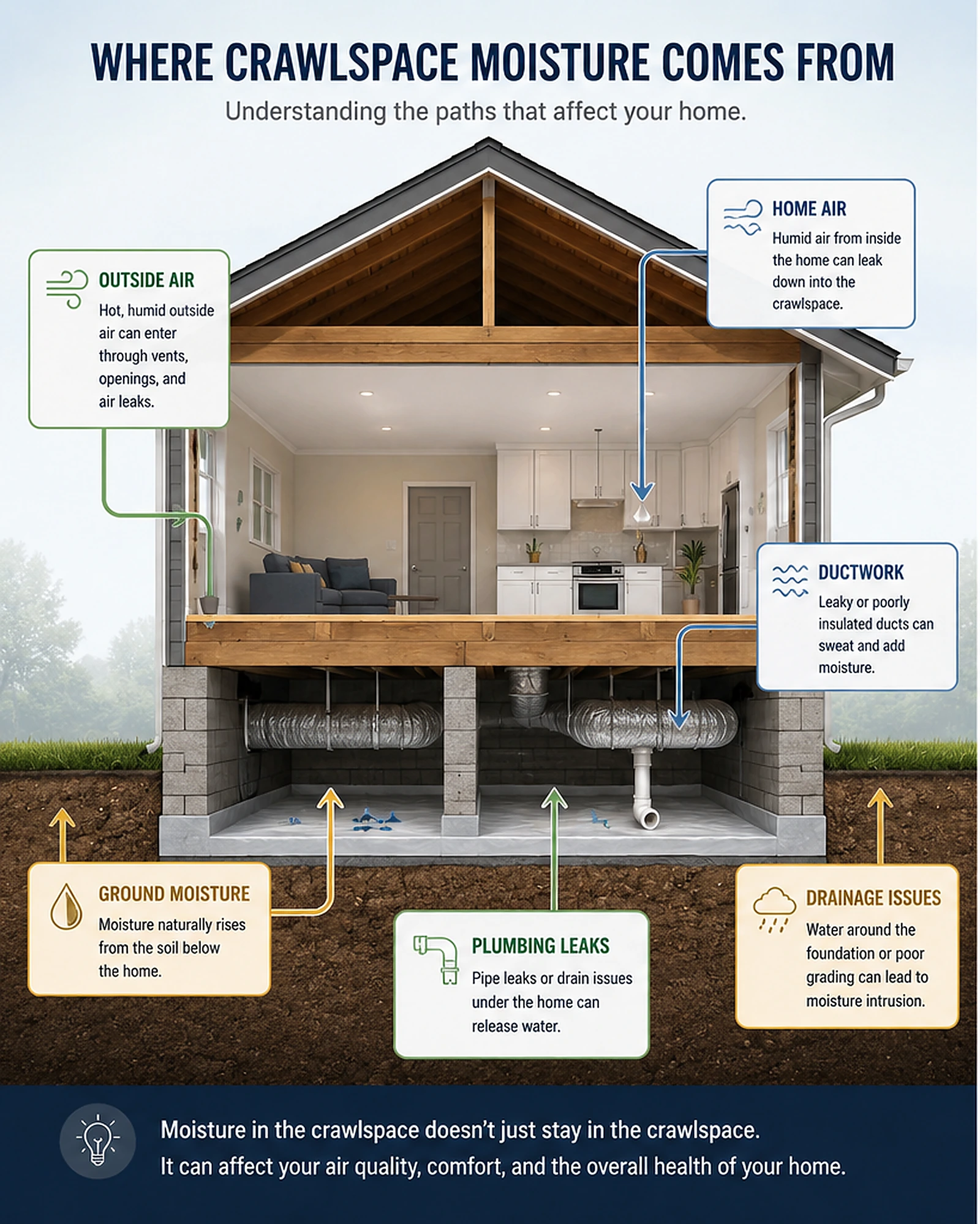
Read this graphic as text
A house cross-section labelling six moisture paths into a crawlspace: humid outside air entering through foundation vents, humid indoor air leaking down from the living space, ground moisture rising from exposed soil, plumbing leaks or drain problems releasing water, drainage and grading faults around the foundation, and ductwork that sweats when poorly insulated. Crawlspace air then moves up into the home.
Signs Your Crawlspace May Be Affecting the House
Crawlspace problems are not always obvious from inside the living area. Some warning signs appear gradually or seem unrelated at first.
What homeowners usually notice first
Any one of these is worth an inspection. Several together usually mean more than one moisture source is active.
Musty or earthy odors
Crawlspace air reaching the living space through floor penetrations and duct leakage.
Indoor humidity you cannot shift
A clammy feeling, longer cooling cycles, and portable dehumidifiers that never quite keep up.
Cupping or moving hardwood
A moisture imbalance between the room above and the space below the floor.
Sagging or fallen insulation
Fiberglass that has absorbed moisture, lost its position, and is now trapping damp against framing.
Condensation on ducts or pipes
Humidity and surface temperature interacting inside the crawlspace.
Rust on equipment or fasteners
Corrosion on HVAC components, supports, enclosures or metal duct suggests prolonged exposure.
Standing water or wet soil
Trace it to a source before anything is sealed. Drainage, grading, plumbing and groundwater are all candidates.
Musty or earthy odors
Odors from a damp crawlspace can move into the home through floor penetrations, duct leakage, plumbing openings, and natural air movement.
A persistent musty smell does not automatically identify the exact cause. It does indicate that the crawlspace, duct system, or another moisture-prone area should be inspected.
High indoor humidity
A humid crawlspace can contribute moisture to the rest of the home, especially when the floor system has air leaks or HVAC ductwork runs underneath the house.
Homeowners may notice:
- A clammy indoor feeling
- Condensation on supply registers
- Longer cooling cycles
- Difficulty maintaining comfortable conditions
- Increased dependence on portable dehumidifiers
Cupping or movement in hardwood floors
Wood flooring can respond to moisture differences between the room above and the crawlspace below. Cupping, crowning, gaps, or movement may indicate a moisture imbalance that deserves further investigation.
Flooring damage has multiple possible causes, so the crawlspace should be evaluated as one part of the diagnosis.
Sagging or fallen insulation
Fiberglass insulation installed between floor joists can absorb moisture, become dirty, sag, or fall. Once displaced, it no longer performs as intended and may trap moisture against framing.
Condensation on ducts or pipes
Visible moisture on ductwork, refrigerant lines, plumbing, or metal surfaces is a strong sign that humidity and surface temperature are interacting inside the crawlspace.
Rust, corrosion, or damp equipment
Corrosion on HVAC components, fasteners, supports, electrical enclosures, or metal ductwork may indicate prolonged moisture exposure.
Standing water or wet soil
Water beneath the home should be traced to its source before encapsulation begins. The cause may involve drainage, grading, plumbing, groundwater, or foundation conditions.
Worth pausing on
Sealing is not a substitute for fixing
Encapsulating over an unresolved water problem can hide the symptom without correcting it. Where the water is coming from has to be answered before the barrier goes down.
What a Crawlspace Dehumidifier Does
A crawlspace dehumidifier removes moisture from the air and drains the collected water away from the unit.
It can help stabilize conditions after the crawlspace has been properly evaluated and obvious moisture sources have been addressed.
A dedicated crawlspace unit is typically designed to operate in a demanding environment and manage a larger moisture load than a small portable household dehumidifier.
A properly planned installation should account for:
- Crawlspace size and layout
- Existing air leakage
- Moisture entering through the ground or walls
- Drainage for collected water
- Electrical requirements
- Access for maintenance
- Filter replacement
- Air circulation throughout the space
A dehumidifier can be an important part of the solution. It should not be expected to overcome unlimited moisture entry.
What a Dehumidifier Cannot Fix
A dehumidifier does not repair:
- Active plumbing leaks
- Standing water
- Poor exterior grading
- Failed gutters or downspouts
- Groundwater intrusion
- Open soil exposure
- Damaged foundation drainage
- Major air leakage
- Disconnected HVAC condensate drains
- Wet or contaminated insulation
- Structural deterioration
Running a dehumidifier in a crawlspace with unresolved water intrusion may increase energy use while leaving the actual problem untouched.
The first step should be source control. Dehumidification follows once the moisture load has been reduced to a manageable level.
What Crawlspace Encapsulation Actually Means
Crawlspace encapsulation is a coordinated system intended to separate the crawlspace from exposed soil, uncontrolled outdoor air, and other moisture sources.
The exact scope varies by home. A complete project may include:
- A heavy-duty ground vapor barrier
- Sealed seams and overlaps
- Treatment around foundation piers
- Sealing around penetrations
- Wall attachment and termination details
- Foundation-vent evaluation
- Air sealing
- Drainage corrections
- Removal of damaged insulation
- Crawlspace dehumidification
- Condensate drainage
- Moisture monitoring
- Access-door improvements
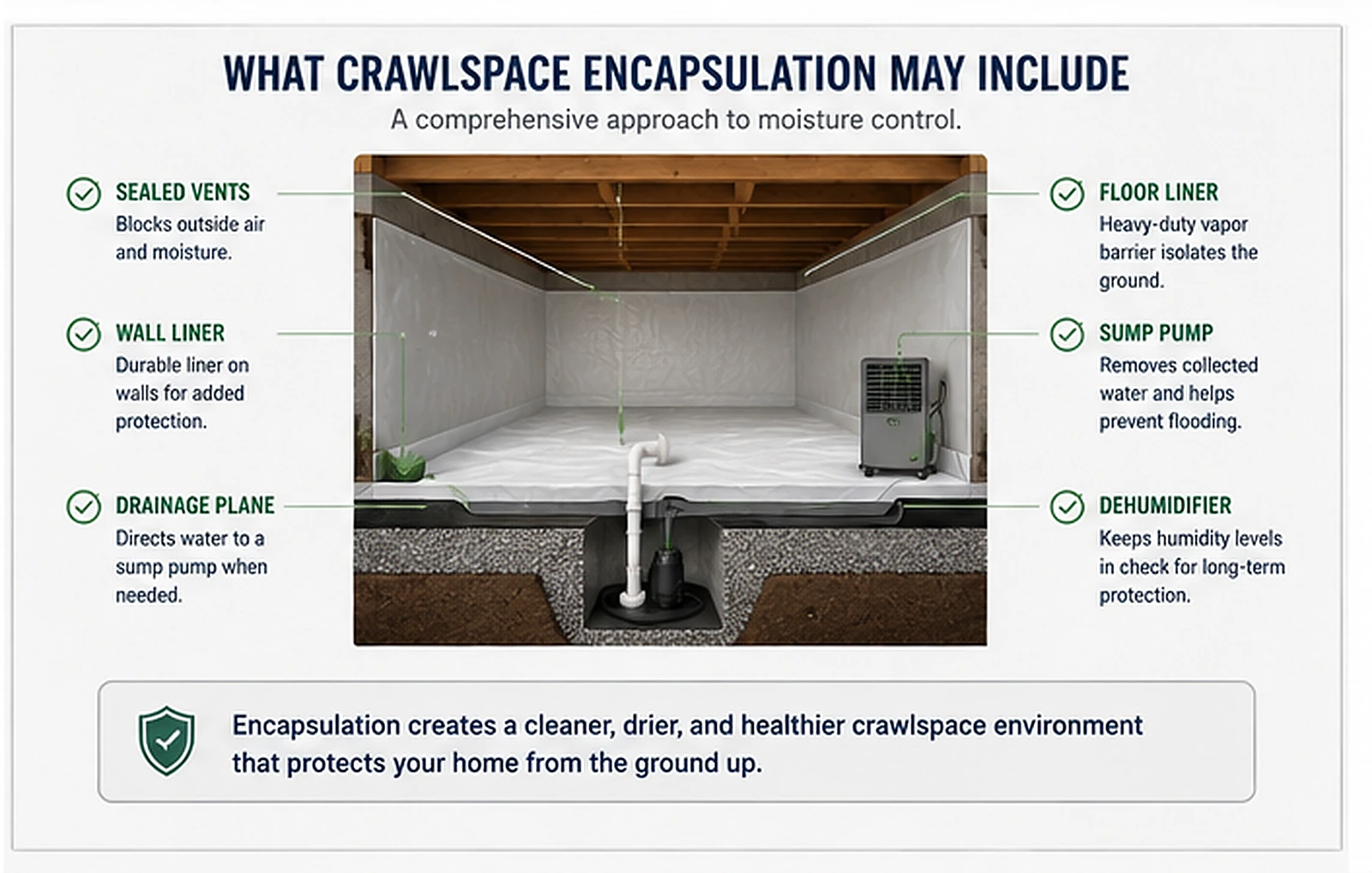
Read this graphic as text
A sealed crawlspace showing six components: sealed foundation vents, a wall liner carried up the foundation, a heavy-duty floor liner over the soil, a drainage plane directing water to a sump pump, the sump pump itself, and a dehumidifier holding humidity steady.
Some homes need every item on that list. Others need a narrower scope.
The quality of an encapsulation project depends heavily on preparation and detail work. A sheet of plastic loosely placed over the soil is not equivalent to a sealed crawlspace system.
Dehumidification and encapsulation, side by side
They are not competing products. They act on different parts of the same problem, which is why the answer for a given house is often neither one on its own.
A crawlspace dehumidifier
Acts on the air that is already in the space.
- Removes airborne moisture and drains it away
- Holds humidity steady once the load is manageable
- Needs a drainage route, power and maintenance access
- Struggles in an open or continuously wet crawlspace
- Does nothing about soil vapor or vent air entering
Encapsulation
Acts on the boundary the moisture crosses to get in.
- Separates the space from exposed soil and outside air
- Sealed seams, pier treatment and wall termination
- Reduces how much moisture arrives in the first place
- Depends heavily on preparation and detail work
- Does not remove humidity already in the air
Both, in sequence
The common outcome in Middle Tennessee: seal the boundary, then size dehumidification for what is left.
- Encapsulation cuts the moisture load down
- The dehumidifier holds the remainder steady
- The unit runs less because it is not conditioning outdoor air
- Drainage and monitoring are planned as part of the same scope
When a Dehumidifier Alone May Be Enough
A dehumidifier may be appropriate when the crawlspace already has effective moisture control and only needs better humidity management.
Possible conditions include:
- An existing vapor barrier is complete and in good condition
- There is no standing water
- Plumbing and condensate systems are dry
- Exterior drainage is functioning properly
- Air leakage is limited
- The crawlspace remains accessible for maintenance
- Moisture levels can be controlled without continuous excessive operation
Even in these situations, the unit should be selected and installed based on actual site conditions.
A dehumidifier placed in an open, highly vented, or poorly sealed crawlspace may spend much of its time trying to condition humid outdoor air.
When Encapsulation Is the Better Long-Term Approach
Encapsulation may be warranted when the crawlspace has persistent moisture exposure that cannot be managed effectively with a dehumidifier alone.
Common examples include:
- Large areas of exposed soil
- A missing or badly damaged vapor barrier
- Recurring musty odors
- Humid outside air entering through foundation vents
- Wet or fallen insulation
- Condensation on ductwork
- Damp foundation walls or piers
- Repeated flooring concerns
- HVAC equipment or ducts operating in a humid environment
- Previous moisture treatments that did not address the whole space
Encapsulation reduces the amount of uncontrolled moisture entering the crawlspace. A dehumidifier can then manage the remaining moisture more efficiently.
When You May Need Both
Many crawlspaces benefit from both encapsulation and dedicated dehumidification.
Encapsulation controls moisture at the boundaries. The dehumidifier controls moisture remaining in the air.
The combination may be appropriate when:
- The crawlspace contains extensive exposed soil
- Humidity remains elevated after sealing work
- Ductwork runs beneath the home
- The crawlspace has several connected sections
- Seasonal humidity changes are significant
- The homeowner wants active moisture control and monitoring
- The space contains equipment that should be protected from damp conditions
A properly designed system should also provide a reliable drainage route for the dehumidifier. Collecting water without safely removing it creates another maintenance problem.
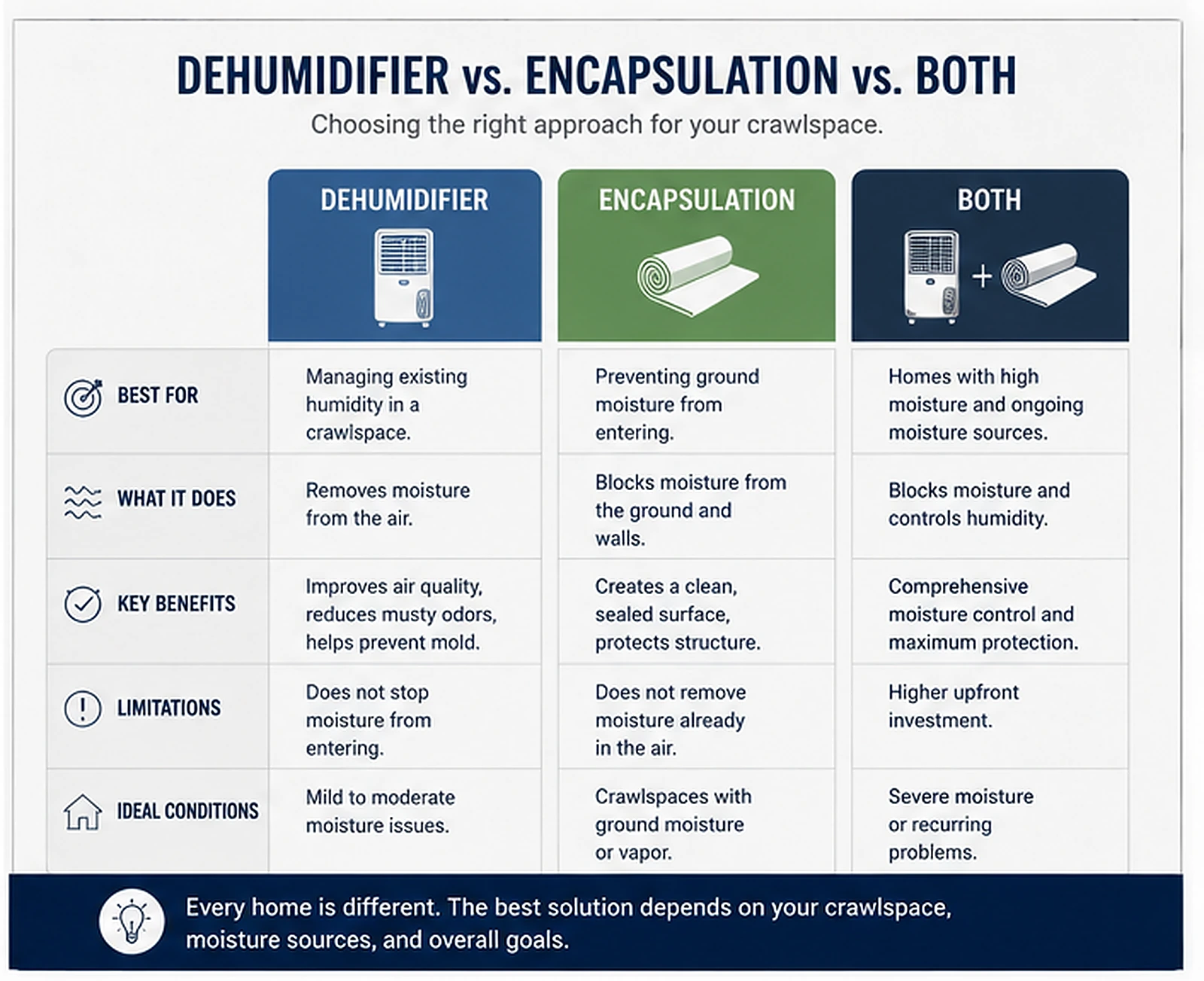
Which starting point matches your crawlspace
Read down the left column for the condition that sounds most like your house.
If there is standing water, wet soil, or a drainage or plumbing problem
Source correction comes first
Grading, downspouts, foundation drainage or the leak itself. Sealing or dehumidifying over active water leaves the cause running.
If the barrier is complete and in good condition, the space is dry, and humidity is the remaining complaint
Dehumidification may be enough on its own
Worth confirming that air leakage is limited first — an open, vented crawlspace gives a dehumidifier an unwinnable job.
If there is large exposed soil, a missing or damaged barrier, or humid air coming in through the vents
Encapsulation is the part doing the work
Reduces how much moisture arrives. Whether a dehumidifier is then needed depends on what the space measures once it is sealed.
If the space is large or sectioned, ductwork runs beneath the house, or humidity stays high after sealing
Both, planned together
The combination most Middle Tennessee homes land on. Drainage for the unit is designed in rather than added afterwards.
These are starting points for an evaluation, not a diagnosis. Which one applies depends on site conditions a technician has to see.
Why the Crawlspace Affects HVAC Performance
The crawlspace and HVAC system should not be evaluated as isolated parts of the house.
When ductwork passes through a hot, humid, or damp crawlspace, several problems can occur:
- Conditioned air can escape through duct leaks
- Humid crawlspace air can enter return ducts
- Condensation can form on cold duct surfaces
- Damaged duct insulation can reduce performance
- Moisture can affect metal components and connections
- Odors can travel through the air-distribution system
A homeowner may assume the HVAC equipment is failing when the real comfort problem also involves duct leakage, insulation, air sealing, or crawlspace moisture.
Replacing the outdoor unit alone will not correct those surrounding conditions.
QSI evaluates how the equipment, ductwork, insulation, and crawlspace interact so the recommendation addresses the system rather than one visible symptom. That is the same whole-system approach we bring to heating and cooling work.
What QSI Evaluates Before Recommending Work
A crawlspace recommendation should begin with inspection and diagnosis.
Qualified Service & Installation evaluates conditions such as:
What we evaluate
The barrier is judged on its details, not its presence
A crawlspace can have a vapor barrier and still behave like bare soil. Coverage, thickness, seam overlap, wall attachment and the treatment around piers and penetrations are what decide whether it is doing anything — which is why the inspection looks at those rather than simply noting that plastic is down there.
Water entry
We look for standing water, wet soil, foundation seepage, drainage problems, plumbing leaks, and condensate issues.
Existing vapor barrier
We evaluate its coverage, thickness, seams, condition, wall attachment, and treatment around piers and penetrations.
Humidity and condensation
We look for signs of prolonged moisture exposure on framing, ducts, insulation, pipes, equipment, and fasteners.
Ductwork
We inspect for disconnections, damaged insulation, air leakage, condensation, and workmanship issues that may affect comfort.
Insulation
We evaluate whether insulation is present, properly installed, damp, compressed, displaced, or trapping moisture against building materials — and whether spray foam insulation is the better fit for the assembly.
Ventilation and air leakage
We consider foundation vents, access doors, penetrations, rim areas, and other pathways that allow uncontrolled air movement.
Existing dehumidification
We review the unit’s placement, drainage, maintenance access, operating condition, and whether it is appropriate for the space.
Related concerns
Visible discoloration, damaged wood, odors, corrosion, or structural movement may require additional evaluation. Discoloration should not automatically be identified as mold without appropriate confirmation.
Encapsulation Does Not Replace Water Management
One of the most important distinctions is the difference between water intrusion and airborne humidity.
Encapsulation can help control ground vapor and air movement. It should not be used to conceal active water entry.
Before sealing a crawlspace, the project may need to address:
- Downspout discharge
- Exterior grading
- Foundation drainage
- Plumbing leaks
- Condensate routing
- Sump or drainage systems
- Entry points around utilities
- Water flowing beneath or through the foundation
The finished system is only as reliable as the preparation beneath it.
Questions to Ask Before Hiring a Crawlspace Contractor
Questions to ask before approving a crawlspace project
Tick them off during the visit, or print this page and take it with you.
Ticks are not saved anywhere — this is a scratch pad for a phone call, not an account. Use your browser's print command for a paper copy.
A credible contractor should be able to explain why each part of the proposed scope is necessary.