When an air conditioner stops cooling or a heating system fails, homeowners usually face two questions:
Can it be repaired?
Should it be repaired?
Those are not always the same question.
A technician may be able to replace a failed component and restore operation. That does not necessarily mean the repair is the best long-term use of your money. At the same time, an older system should not automatically be condemned simply because replacement would produce a larger invoice.
The right decision depends on the equipment, the failure, the repair history, the condition of the rest of the system, and how well the home is performing overall.
For Nashville and Middle Tennessee homeowners, the decision should also account for long cooling seasons, humid weather, winter temperature swings, ductwork condition, insulation, and crawlspace moisture. HVAC equipment does not operate in isolation. A new unit cannot fully correct comfort problems caused by leaking ducts, weak insulation, poor airflow, or uncontrolled moisture beneath the home.
This guide explains how to compare repair and replacement without relying on fear, pressure, or a simplistic formula.
Start With the Immediate Question: What Actually Failed?
Before discussing replacement, the system needs a real diagnosis.
A home that is not cooling could have a problem involving:
- A failed capacitor
- A contactor or relay
- A thermostat
- A condensate safety switch
- A clogged drain
- A blower motor
- A condenser fan motor
- A refrigerant-related issue
- An electrical problem
- A damaged control board
- Restricted airflow
- Dirty or obstructed coils
- Disconnected or leaking ductwork
- A compressor or other major component
These failures are not equal in cost, severity, or long-term significance.
A relatively small electrical component on an otherwise healthy system presents a different decision than a major mechanical failure on equipment that has already required repeated repairs.
The first step is therefore not asking, “How old is the unit?” The first step is asking:
What failed, why did it fail, and what else is likely to need attention?
Age Matters, but Age Alone Does Not Decide
Every HVAC system has a service history that matters more than a number printed on the data plate.
Two systems of the same age can be in very different condition. One may have:
- Consistent maintenance
- Proper airflow
- Clean coils
- Correct refrigerant charge
- Protected electrical components
- Well-sealed ductwork
- Moderate operating conditions
The other may have:
- Years of deferred maintenance
- Chronic airflow restriction
- Repeated electrical failures
- Water or moisture exposure
- Damaged ductwork
- Improper installation
- Heavy runtime caused by building-envelope problems
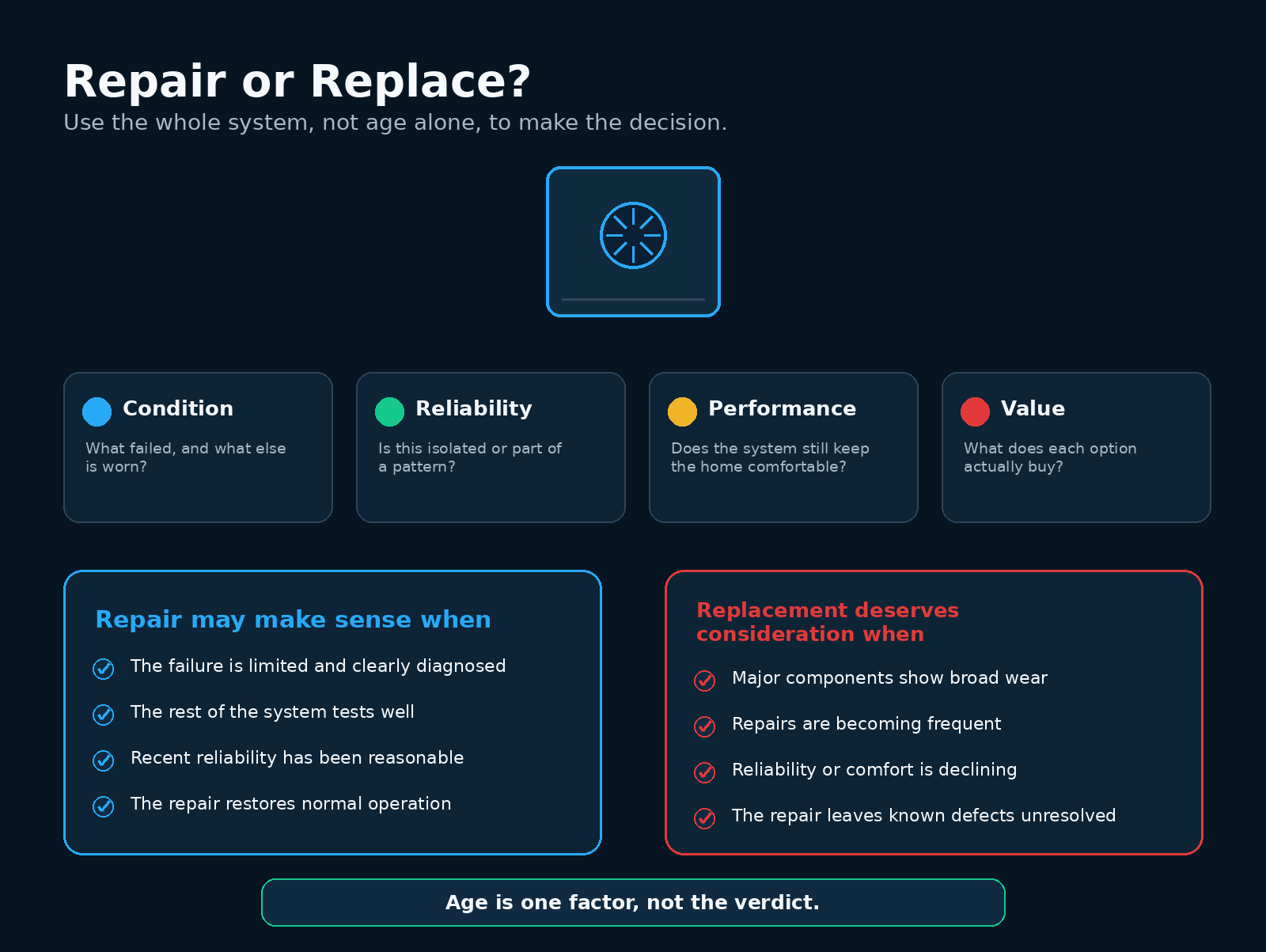
Age should be treated as one factor in the decision, not a verdict.
An older system with a minor, isolated failure may still be worth repairing. A newer system with recurring problems, poor installation, or significant component damage may deserve a broader evaluation.
Two assumptions worth setting down
- Often assumed
Past a certain age, a system is not worth repairing.
In practiceTwo systems of the same age can be in very different condition. Maintenance history, airflow, installation quality and operating conditions matter more than the number on the data plate.
- Often assumed
A large repair estimate means it is time to replace.
In practiceIt means it is time for a broader comparison — system condition, repair history, remaining defects, warranties and the complete cost of replacement. The question is what value each option provides, not which invoice is bigger.
The Most Important Repair Question: Is This an Isolated Failure?
A repair is easier to justify when the failed part appears to be an isolated problem.
For example, repairing may make sense when:
- The failure is limited to one serviceable component
- The rest of the system tests well
- The equipment has not required repeated major repairs
- The repair restores normal operation without leaving another known failure unresolved
- The system still provides reasonable comfort
- Parts remain available
- The repair cost is proportionate to the system’s remaining usefulness
- There is no known safety issue
- The homeowner needs a practical short-term solution
Replacement becomes more reasonable when the current failure is part of a larger pattern. Warning signs include:
- Multiple repairs over a short period
- Repeated loss of cooling or heating
- Major component failures
- Increasing electrical problems
- Significant corrosion
- Refrigerant-related problems that are expensive or difficult to resolve
- Poor airflow that has damaged or stressed equipment
- Obsolete or difficult-to-source parts
- A repair that leaves other known defects in place
- Major installation deficiencies
- Comfort problems that persist after previous repairs
The decision should be based on the condition of the entire system, not only the part that failed today.
Isolated failure, or part of a pattern?
Four situations a technician sees regularly. Open each one for what it usually points at — possible contributors, not a diagnosis.
One component failed, everything else tests wellA capacitor, a contactor, a fan motor. The system ran normally until it did not.What this usually points at
What this usually points at
- A repair that restores full operation rather than postponing a failure
- Worth confirming the rest of the system tests clean, not just the failed part
- Ask whether anything caused the failure — airflow or electrical conditions can take out the same part twice
- No safety issue outstanding, and parts readily available
Several unrelated repairs in a short periodDifferent components, different visits, no single root cause tying them together.What this usually points at
What this usually points at
- A system reaching the point where each repair is one payment in a series
- Worth checking whether one earlier issue caused damage elsewhere
- Reliability during extreme weather becomes the practical question
- A broader evaluation is more useful than another component quote
Comfort never returns after the repairThe equipment runs again, but the same room is still wrong and the humidity is unchanged.What this usually points at
What this usually points at
- Restoring operation and solving comfort are two different tasks
- Duct leakage, return-air capacity or distribution rather than the equipment
- Insulation, air sealing or crawlspace conditions contributing to the load
- Replacing the equipment alone would likely reproduce the complaint
Parts are becoming difficult to sourceLonger waits, substitutions, or a component that is no longer manufactured.What this usually points at
What this usually points at
- Downtime risk during the season you can least afford it
- Worth asking what the next likely failure is and whether that part is available
- Changes the value calculation even when today's repair is affordable
- A planned replacement removes the scramble; an unplanned one does not
Compare the Repair Cost to What the Repair Actually Buys
A repair estimate tells you the cost of restoring a specific function. It does not automatically tell you how much useful service life the repair will provide.
Ask what the repair accomplishes:
- Does it restore full operation?
- Does it resolve the root cause?
- Does it only replace the part that failed?
- Are other weakened components still present?
- Is the repair expected to be durable?
- Does the system remain properly matched?
- Will the repair improve comfort or only make the equipment run again?
- Is there a warranty on the replacement part and labor?
- Are there other known repairs likely in the near future?
A lower-priced repair can be the financially responsible choice when it restores an otherwise dependable system. It can become expensive when it is one payment in a continuing sequence of breakdowns.
Review the System’s Recent Repair History
Homeowners often evaluate each service call independently. The better approach is to look at the pattern.
Gather the last several years of:
- Repair invoices
- Maintenance records
- Refrigerant work
- Electrical repairs
- Motor replacements
- Drainage problems
- Thermostat issues
- Warranty claims
- Comfort complaints
- Utility-bill changes
Then ask:
- How often has the system failed?
- Are the failures related?
- Has one issue caused damage elsewhere?
- Are repairs becoming more frequent?
- Has the system become less reliable during extreme weather?
- Have previous repairs restored comfort?
- Are parts becoming harder to obtain?
- Is the system likely to require another major investment soon?
Read this graphic as text
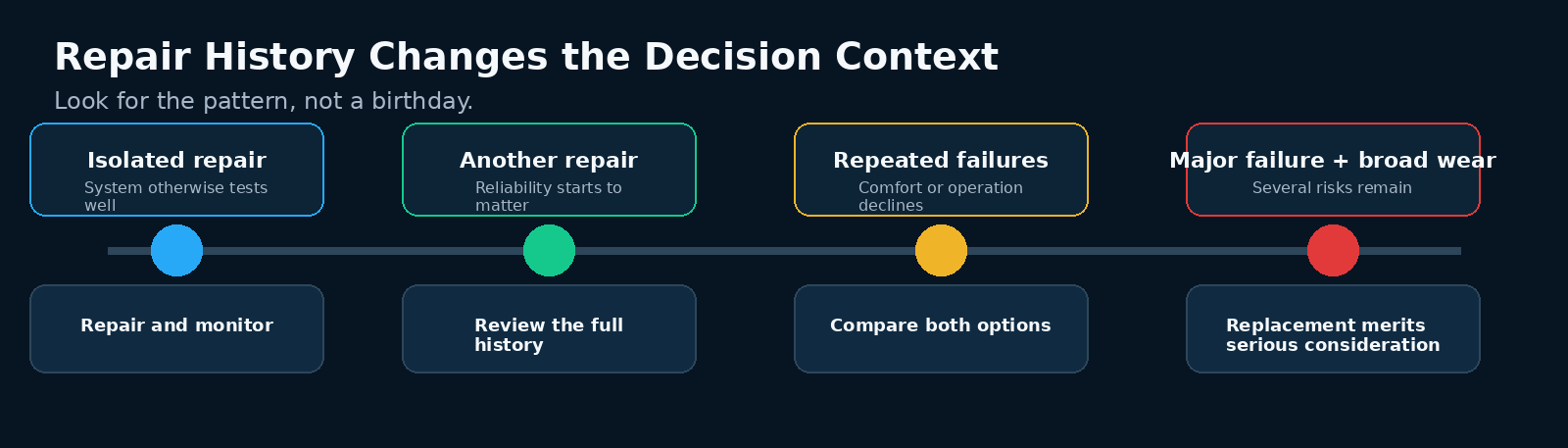
Four points along a timeline of repair events. An isolated repair on a system that otherwise tests well: repair and monitor. A second repair as reliability starts to matter: review the full history. Repeated failures with comfort or operation declining: compare both options. A major failure alongside broad wear with several risks remaining: replacement merits serious consideration.
One repair may be reasonable. Several unrelated failures within a short period may indicate that the equipment is reaching the point where continued repairs no longer provide good value.
Comfort Problems Can Change the Decision
An HVAC system may technically run while still performing poorly. Homeowners may experience:
- Rooms that never reach the thermostat setting
- Large temperature differences between floors
- Weak airflow from certain registers
- Excessive indoor humidity
- Long operating cycles
- Frequent starting and stopping
- Noise or vibration
- Hot or cold bonus rooms
- Musty odors
- Condensation around registers or ductwork
- A system that struggles during peak summer or winter conditions
These symptoms do not automatically mean the equipment needs replacement. They can also point to:
- Leaking or disconnected ductwork
- Undersized return-air pathways
- Restricted airflow
- Poorly designed duct runs
- Damaged duct insulation
- Inadequate attic insulation
- Air leakage through the building envelope
- Crawlspace moisture
- Incorrect equipment sizing
- Thermostat-placement problems
- Installation defects
Replacing the equipment without evaluating these conditions may leave the homeowner with a new system and many of the same comfort complaints.
A New Unit Cannot Fix Bad Ductwork
Ductwork is one of the most commonly overlooked parts of a repair-or-replace decision.
A heating and cooling system depends on the ducts to move air throughout the home. Problems can include:
- Disconnected sections
- Crushed or restricted flex duct
- Leaking seams
- Poorly sealed plenums
- Damaged insulation
- Inadequate return air
- Incorrect duct sizing
- Excessive bends
- Unbalanced airflow
- Ducts exposed to damp crawlspace conditions
When air does not move properly, the equipment may run longer, struggle to maintain comfort, or experience unnecessary stress.
Installing new HVAC equipment on a defective duct system can reduce the value of the replacement. The equipment may be more efficient on paper while the home continues losing conditioned air before it reaches the rooms.
A replacement proposal should therefore answer:
Has the duct system been inspected, and can it support the proposed equipment?
Insulation and Air Leakage Matter Too
A home can lose comfort through more than the HVAC system. Inadequate insulation and uncontrolled air leakage can cause:
- Hot upstairs rooms
- Cold floors
- Long operating cycles
- Drafts
- Temperature swings
- High humidity
- Difficulty maintaining thermostat settings
- Excessive load on heating and cooling equipment
Replacing a system without addressing major insulation or air-sealing deficiencies may produce only a partial improvement.
This does not mean every HVAC replacement should become a whole-house renovation. It means the recommendation should account for the conditions that affect system performance.
QSI evaluates heating and cooling equipment together with ductwork, insulation, and crawlspace conditions when those systems may be contributing to the problem.
Crawlspace Conditions Can Affect HVAC Performance
Many Middle Tennessee homes contain ductwork or mechanical equipment in the crawlspace.
A damp or poorly controlled crawlspace can contribute to:
- Condensation on ducts
- Damaged duct insulation
- Air leakage
- Corrosion
- Musty odors
- High indoor humidity
- Reduced comfort
- Moisture exposure around electrical or mechanical components
A homeowner may believe the air conditioner is failing because the house feels humid or unevenly cooled. The equipment may be part of the problem, while crawlspace moisture and duct conditions also need attention.
Replacing the unit alone will not seal disconnected ducts or control moisture beneath the home. Our article on encapsulation versus a crawlspace dehumidifier covers how to tell which one a house actually needs, and crawlspace encapsulation explains the work itself.
Energy Bills Are Evidence, Not a Diagnosis
Increasing utility bills can signal that an HVAC system is operating less effectively, but the bill alone does not identify the cause.
Higher energy use may result from:
- Equipment wear
- Dirty coils
- Restricted airflow
- Duct leakage
- Poor insulation
- Air leakage
- Thermostat settings
- More extreme weather
- Longer occupancy
- Additional household equipment
- Rate changes from the utility
- Humidity problems
- A malfunctioning component
Compare bills over similar seasons and consider changes in weather, occupancy, and energy rates.
A technician should evaluate system operation before concluding that replacement will produce a specific amount of savings.
A promise nobody can keep
Avoid any contractor who guarantees a precise reduction in your power bill without a detailed analysis of the home and its usage.
When Repair Is Often the Better Choice
Repair may be the more responsible option when:
- The problem is clearly diagnosed
- The failed component is serviceable
- The repair is relatively limited
- The rest of the system is in good condition
- The system has not experienced repeated major failures
- Parts remain reasonably available
- The equipment still maintains comfort
- The homeowner plans to remain in the home only briefly
- A replacement is not currently practical
- The repair provides meaningful value for its cost
A trustworthy recommendation should acknowledge when a repair can reasonably keep the system operating. A system does not need to be replaced simply because replacement is available.
When Replacement Deserves Serious Consideration
Replacement may be more appropriate when:
- A major component has failed
- The system has required repeated repairs
- Reliability has become unacceptable
- Several components show significant wear
- Parts are obsolete or difficult to source
- Corrosion or moisture damage is extensive
- The system cannot maintain comfort
- Airflow or installation problems require substantial correction
- Heating and cooling equipment are poorly matched
- The repair cost is high relative to the system’s overall condition
- The homeowner expects to remain in the property for several years
- The replacement can address documented design or installation problems
- Continued repairs are likely to delay an unavoidable replacement
Replacement should solve a defined problem. It should not be presented as the default answer to every service call.
Repairing Now and Planning Replacement Later
The decision is not always limited to “repair forever” or “replace today.”
A short-term repair may be appropriate when:
- The repair is affordable and likely to restore reliable operation
- The homeowner needs time to budget
- The failure occurs during extreme weather
- Replacement options need to be evaluated carefully
- Ductwork or insulation work should be planned with the new system
- The homeowner wants to compare equipment and financing without pressure
In this situation, the technician should explain:
- What the repair is expected to accomplish
- What risks remain
- Which warning signs to watch
- Whether the repair affects future replacement decisions
- What planning should happen next
- Whether the system should receive additional testing
Say the quiet part out loud
A temporary repair should be described honestly as temporary when that is what it is.
Questions to Ask Before Approving a Repair
Ask the technician
A clear answer should include evidence from the inspection, not only a recommendation.
Ticks are not saved anywhere — this is a scratch pad for a phone call, not an account. Use your browser's print command for a paper copy.
A clear answer should include evidence from the inspection, not only a sales recommendation.
Questions to Ask Before Approving Replacement
Ask before signing for a replacement
A replacement should be designed around the home, not selected by matching the old equipment's label.
Ticks are not saved anywhere — this is a scratch pad for a phone call, not an account. Use your browser's print command for a paper copy.
A replacement should be designed around the home, not selected only by matching the old equipment’s label. Where the new equipment is gas-fired, the piping, shutoff and venting scope should be quoted with it — our guide to adding a gas appliance covers what that involves.
Beware of Pressure-Based Replacement Tactics
Worth pausing on
Urgency is not the same as evidence
A heat wave or a hard freeze can genuinely require a fast decision. That does not remove the need for a clear explanation of what failed, what the options are, and what each one leaves unfixed.
Homeowners should be cautious when a contractor:
- Declares the system “too old” before diagnosing it
- Refuses to discuss repair
- Uses fear without showing evidence
- Claims replacement is required without explaining why
- Guarantees a specific utility-bill reduction
- Pushes an immediate decision before providing a written scope
- Treats every comfort problem as an equipment problem
- Ignores ductwork and airflow
- Uses an expiring discount to prevent comparison
- Cannot explain what the proposed replacement will correct
Urgent weather conditions may require a quick decision. That does not remove the need for a clear explanation.
Beware of Repairs That Only Delay the Same Failure
Pressure can work in the opposite direction too.
A very inexpensive repair is not necessarily a good value if it:
- Ignores the root cause
- Leaves a major defect unresolved
- Restores operation only briefly
- Requires a part with no meaningful warranty
- Adds money to a system with several known failures
- Delays a replacement the homeowner already knows is necessary
- Leaves a safety concern in place
- Does not address damaging airflow or electrical conditions
The goal is not always to choose the lowest invoice today. The goal is to choose the option that provides the best responsible value based on the system’s condition.
How to Compare the Two Options
Use a written comparison instead of relying on instinct.
What each option has to account for
Write both columns down before deciding. A replacement with a low advertised price may exclude necessary ductwork or electrical work; a repair may look inexpensive while leaving several risks unresolved.
Repairing
Restores a specific function. Whether that is good value depends on what else is waiting.
- Immediate repair cost, and parts and labour warranty
- Known remaining defects the repair does not touch
- What has already been spent over recent years
- Expected reliability, and the next likely piece of work
- Whether the root cause is corrected or only the symptom
Replacing
Should solve a defined problem. Ask which problems it will not solve.
- Complete installed cost, not equipment price alone
- Ductwork modifications, electrical and drainage work included
- Equipment and labour warranty terms
- Which comfort complaints the new system is expected to fix
- Which existing conditions will remain afterwards
Repair now, plan replacement later
A legitimate third answer when the repair is limited and restores safe operation.
- Buys time to budget and to compare scope without pressure
- Lets duct or insulation work be planned alongside the new system
- The technician should say plainly that it is a temporary measure
- Ask which warning signs would change the timetable
Repair option
Record:
- Immediate repair cost
- Parts and labor warranty
- Known remaining defects
- Recent repair spending
- Expected reliability
- Likely near-term work
- Comfort after repair
- Whether the root cause is corrected
Replacement option
Record:
- Complete installed cost
- Included equipment
- Efficiency level
- Equipment and labor warranty
- Ductwork modifications
- Electrical or drainage work
- Comfort improvements expected
- Problems the replacement will not correct
- Maintenance requirements
- Financing cost, when applicable
Then compare what each option actually delivers.
A replacement with a low advertised price may exclude necessary ductwork or electrical work. A repair may appear inexpensive while leaving several major risks unresolved.
A Simple Decision Framework
Consider the following four categories.
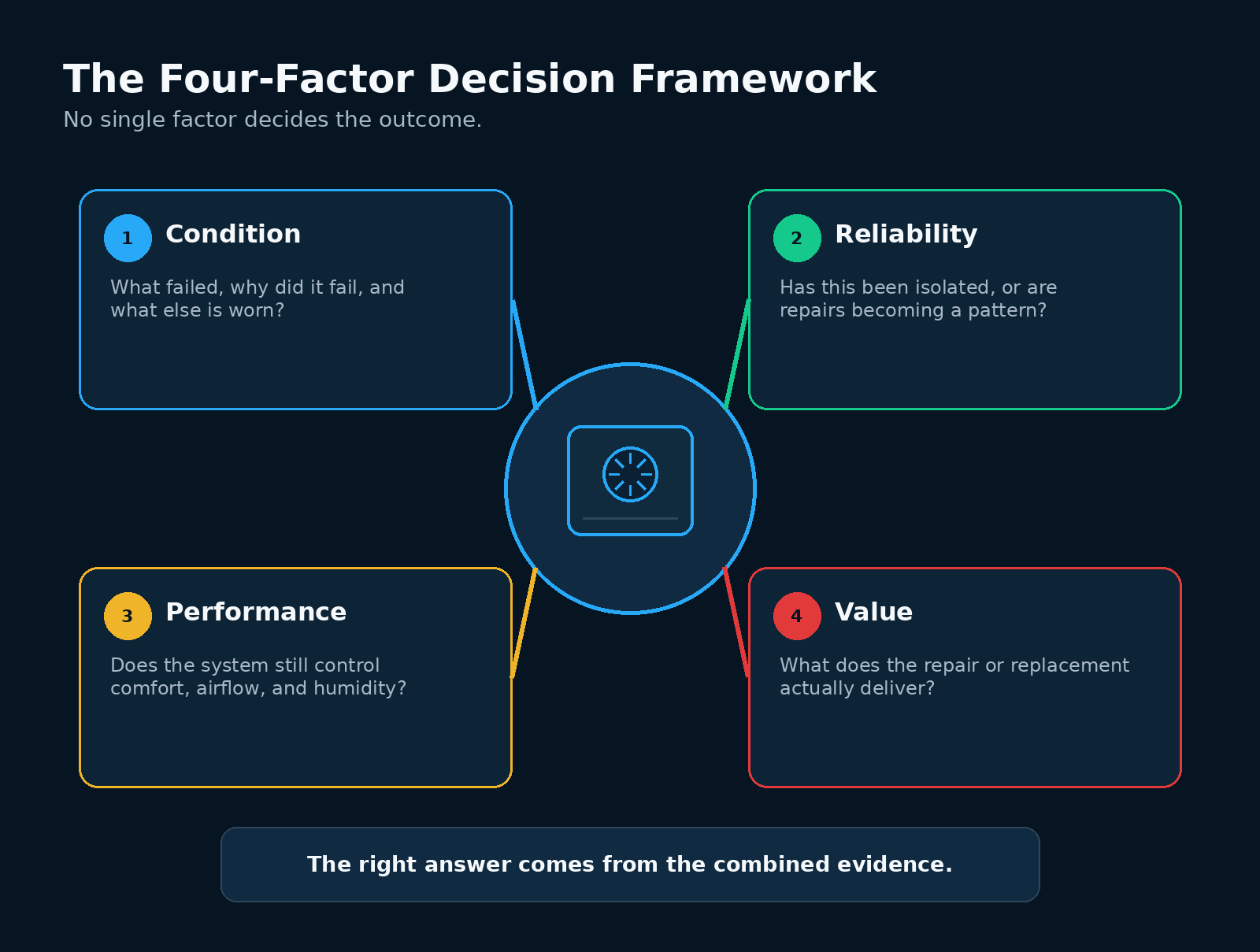
1. Condition
Is the system generally sound, or are several components deteriorating?
2. Reliability
Has it been dependable, or has it required repeated service?
3. Performance
Does it maintain comfort with reasonable operation, or does it struggle even when running?
4. Value
Will the proposed repair provide meaningful service, or is it one more investment in a system likely to fail again?
No single category should decide the answer by itself.
What an Honest HVAC Recommendation Should Include
A responsible recommendation should explain:
- The current failure
- The cause, where it can be determined
- The system’s overall condition
- Available repair options
- Available replacement options
- What each option includes
- What each option does not include
- Any immediate safety concern
- The condition of the ductwork
- Relevant airflow problems
- Expected limitations
- Warranty differences
- The homeowner’s practical timeline
The homeowner should understand why the recommendation was made before approving the work. If you would like that explanation for your own system, get in touch and describe what the house is doing.
If you remember four things
- Ask what failed and why before anyone discusses replacement.
- One isolated failure and a pattern of failures are different decisions, even at the same age.
- Ask what the repair buys — full operation, or another few months before the next call.
- Get the ductwork inspected before a replacement is priced. New equipment on defective duct inherits the same complaints.